
Meta's Ads Are Flying. So Where Did the Cash Go?
Current portfolio~$315K Road to $1M31.5% Updated Oct 16, 2026 →I opened Meta’s earnings expecting two things: another ridiculous advertising quarter, and another even more ridiculous infrastructure spending number.
Well, I got both.
Revenue reached $64.6 billion, up 26% from last year. Ad impressions grew 10% and the price advertisers paid per ad climbed 14%. That’s an absurdly effective business for something used by billions of people who aren’t thinking about advertising auctions when they open Instagram.
Then I got to the cash flow statement.
Meta generated $32.79 billion in operating cash and spent $34.91 billion on capital expenditures, including principal payments on finance leases. Free cash flow was negative $2.12 billion. A year ago it had generated positive $10.63 billion in the same quarter. Meta’s Q3 release.
I’m a shareholder, so I have a pretty obvious question: how much of the money being made by one of the best advertising businesses on the planet is eventually going to belong to me?
That was already the uncomfortable part of my Meta thesis. Q3 made it harder to wave away.
The business I bought is doing its job
There’s a reason I own Meta. It has enormous distribution, real customer habits, and an advertising engine that gets better when the recommendations and measurement get better. An AI improvement doesn’t require me to believe every Instagram user suddenly pays for a separate chatbot. The next feed ranking or ad recommendation can show up in the existing business.
And the numbers suggest that’s happening.
| Q3 2026 | Reported | A year earlier |
|---|---|---|
| Revenue | $64.60B | $51.24B |
| Advertising revenue | $63.06B | $50.08B |
| Family daily active people | 3.64B | About 3% fewer |
| Ad impressions | +10% y/y | n/a |
| Average price per ad | +14% y/y | n/a |
| GAAP operating income | $12.99B | $20.54B |
| Operating income excluding the Q3 legal charge | $22.88B | $20.54B |
| Q3 operating cash flow | $32.79B | $30.00B |
| Capital spending, including finance-lease principal | $34.91B | Lower |
| Free cash flow | -$2.12B | +$10.63B |
Source: Meta Q3 financial results and reconciliation.
Advertising alone supplied $63.06 billion, around 98% of revenue. Meta’s commercial strength doesn’t depend on the new Muse assistant becoming a paid product tomorrow. That’s a nice position to be in while experimenting with AI.
Management also guided Q4 revenue to $73–76 billion. Using that guidance with the first nine months of reported revenue implies roughly $255–258 billion in full-year sales. In other words, this is hardly a company whose customer demand suddenly fell off a cliff.
I remain very bullish on the existing advertising franchise. The part I need to keep revisiting is what management decides to do with the economics.
The legal charge doesn’t make the rest of the quarter disappear
Reported EPS was $3.83, which looks lousy next to a company growing sales 26%. But Meta booked a $9.89 billion expense tied to its agreement with U.S. state attorneys general over teen mental health and social media. Meta calculated that Q3 EPS excluding this particular charge would have been $7.40. That’s the right starting point for understanding recurring quarterly earning power, not an excuse to pretend the lawsuit never happened. Meta Q3 release.
The operating margin bridge is just as important:
| Profit measure | Q3 margin |
|---|---|
| Reported GAAP | 20.1% |
| Excluding the $9.89B settlement charge | About 35.4% |
| Q3 2025 GAAP | About 40.1% |
So yes, the $9.89 billion explains much of the spectacular year-over-year margin collapse. But even after backing it out, the underlying margin is below last year’s 40%. The business is growing fast while its expense base expands.
I also don’t count every legal cost as some imaginary non-recurring expense that can be excluded forever. Meta’s agreement involves potential payments of up to about $18.59 billion over time. A separate $25 billion New Mexico judgment was reported today; appeals, timing and ultimate liability are uncertain, and I’m not adding $25 billion straight to Q3 expenses. It is another real source of legal and financial risk. Meta Q3 release; Reuters.
Here’s the distinction: the Q3 charge reduces accounting earnings now, but it isn’t the same thing as spending $9.89 billion on data centers this quarter. The negative free cash flow is a separate economic issue that deserves its own scrutiny.
The cash has been redirected
Q3 capex plus finance-lease principal hit $34.91 billion, up from $31.08 billion in Q2. Management narrowed full-year 2026 capex guidance to $135–145 billion, raising the lower end by $5 billion while leaving the upper end unchanged. Meta Q3 release.
That isn’t just a big number on a presentation slide. In the first nine months of 2026, Meta generated $96.87 billion in operating cash. Purchases of property and equipment consumed $83.06 billion, and finance-lease principal another $2.77 billion. That leaves roughly $11.05 billion of nine-month free cash flow on the company’s definition.
Still positive over nine months. But look at how much of the operating cash now has to go straight back into the machine.
More revealingly, share buybacks were zero in Q3 and zero for the first nine months of 2026, compared with $26.25 billion in the first nine months of 2025. Meanwhile Q3 stock-based compensation was $7.36 billion, up from $5.56 billion a year ago. Meta Q3 cash flow statement.
That gets my attention. This company used to be able to spend aggressively, grow the business and repurchase a huge amount of stock at the same time. Now it’s doing a lot more of the first two and none of the third.
A smaller repurchase budget isn’t inherently a mistake. Some reinvestment can earn far more than retiring shares. But if I’m going to own the stock for ten years, I want evidence that building all these facilities produces incremental owner earnings, rather than merely a bigger balance sheet and faster-growing depreciation.
And Reality Labs? Management expects an $18–19 billion segment loss for 2026 and around $15 billion in 2027, as investment shifts toward AI. That’s a narrowing loss, but it’s still an enormous annual claim on what the apps are earning.
Then came a second share class
This might be the most interesting part of the whole announcement.
Meta approved a new publicly listed, non-voting Class C share class, expected to take effect in January 2027. The plan is to distribute one Class C share for each existing Class A or B share. Meta expects that initial transaction to behave economically like a two-for-one stock split while leaving existing voting power unchanged. Meta’s description of the new Class C shares.
That initial distribution is not a magic 50% dilution of my claim on the business. If everyone receives a proportionate extra economic share, everyone still owns the same proportion of the economic pie at the moment of distribution, though the two share classes may trade differently afterward.
The real question is what happens next.
Management says the structure provides flexibility for capital raising, acquisitions and employee compensation. New issuances for those purposes may dilute existing owners. And because these securities carry no vote, Meta can raise capital while preserving Zuckerberg’s control.
I’ve benefited enormously from founder-led businesses. Control can be useful when the founder is right and willing to invest before anybody else sees the opportunity. But how do I hold management accountable for the return on $140 billion of annual capital spending when the voting structure becomes even harder to challenge?
That question now belongs inside the investment thesis. I don’t think it makes Meta a bad business. I do think it makes capital allocation more important than ever.
One very practical detail: all the share values in the rest of this article use pre-Class C-distribution equivalents. A $1,340 model endpoint is not a post-distribution Class A quote target. If the two-for-one economic distribution goes ahead, prices, shares and per-share valuation references will have to be adjusted consistently rather than pretending a split created or destroyed value.
So what does it do to my five-year model?
Before earnings I had a rough $28 normalized annual EPS starting point. The new $7.40 quarter excluding the settlement, the $73–76 billion Q4 revenue guidance and the stronger core business push me toward about $29 of normalized 2026 EPS as my own rough modeling anchor. That’s an estimate, not company guidance or a GAAP restatement.
But a slightly higher earnings starting point doesn’t solve the spending problem. I’ve reduced the expected five-year Base growth rate from 15% to 14% and, more importantly, the terminal P/E from 27x to 24x. A lower multiple is what I’m willing to pay for a company that has shown it can grow ads brilliantly while putting increasingly large amounts of cash at risk.
Here’s the updated math from the completed October 21 pre-announcement close of $708, over five years to October 2031.
| Scenario | EPS growth | 2031 EPS | Exit P/E | 2031 value | Annualized price return |
|---|---|---|---|---|---|
| Bear | 6% | $38.81 | 18x | $698.55 | -0.3% |
| Base | 14% | $55.84 | 24x | $1340.09 | +13.6% |
| Bull | 19% | $69.20 | 29x | $2006.92 | +23.2% |
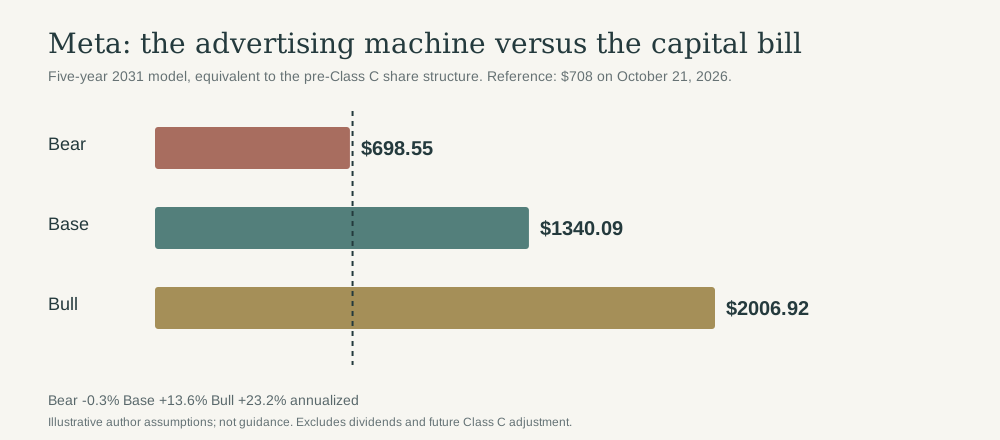
This is not a discounted-cash-flow model, and I don’t want to pretend it is. The critical assumption is that these revenue and AI investments translate into the normalized per-share earnings growth I’m modeling, even after rising depreciation, stock compensation, financing costs and ongoing legal claims. If Meta needs $150–200 billion in annual infrastructure spending for many more years, the economics could look worse than the EPS path suggests.
I also keep the small cash dividend out of the price CAGR calculation rather than treating the Q3 payout as if it were a guaranteed five-year dividend forecast.
My old Base was roughly $1,521, or a 15.1% price CAGR from its September $751.66 reference. The new Base is about $1,340, approximately 13.6% annualized from $708. The share price is lower, yet my central expected return is below the old model. That’s what happens when the expected future economics change.
At the $1,340 unchanged Base endpoint, a 15% annualized price return requires buying around $666. That is just the algebra. I’m not placing a standing order at $666 and ignoring the business or the rest of my portfolio.
What I’m doing with my shares
I own 27.133 shares in the dated Mostly Nothing ledger. At the $708 pre-release close they’re worth a bit over $19,000, about 6% of a roughly $315,000 invested portfolio snapshot. That snapshot isn’t a live brokerage reconciliation, but it’s enough to remind me that this is already a meaningful position.
The business thesis is stronger than ever on advertising monetization. The capital-allocation thesis is less comfortable. I take the Compounder capital-allocation score from 6.5 to 6.0 out of 10: a quarter-point reduction for a less pristine balance-sheet position and another quarter-point for the pause in buybacks while stock compensation and infrastructure spending continue rising. I keep the separate governance concern visible rather than invent a new scoring rule after one announcement.
Am I selling? No. I don’t have evidence that the core franchise is broken or that the capex won’t eventually earn its keep.
Am I adding? Also no. My own 3–6% sizing range already puts this holding near the top, and my portfolio has plenty of other exposure to the same AI buildout through cloud platforms and semiconductor infrastructure.
That’s the difference between loving the business and deciding it needs more of my capital.
The next few quarters are not going to be about whether Meta can grow ad revenue. It has earned credibility there. I’m watching what happens to actual free cash flow, whether the Class C share structure is used to finance or dilute, and how much return on incremental capital the infrastructure ultimately creates.
Meta made $64.6 billion in one quarter. I want to know what I own on the other side of the spending.
Sources
Want the next decision in your inbox?
About one email a week, when there's something worth sending. I share an investment I'm working through, a decision I actually made, or evidence that changed my mind. You'll see the numbers, what still bothers me, and where the money went (if anywhere). It's free, and I have no plans for a paid newsletter. Not an alert for every new page.