
The Next $10,000
Why BRBR got $5,000 — and why I stopped there
Current portfolio~$325K Road to $1M32.5% Updated Oct 6, 2026 →Where the $10K actually went
A CD matured, I had $10,000 to put back to work, and naturally I spent way too much time deciding where it should go. BRBR kept getting absolutely smoked, I kept digging, and somehow the business started looking more interesting while the chart looked worse.
The hypothetical part is over now. On Sep. 29 I put $5,000 into BRBR at about $7.63 and another $5,000 into FXAIX. That took invested assets to roughly $320K.
The interesting part is not really that I bought BellRing. It is that after all that research and all that upside, I still stopped at $5,000.
The temptation to put more than $5,000 into BRBR was real. The sizing work kept pointing back to the same place: 655.308 shares for about $5,000, around 1.6% of the portfolio, and the other $5,000 into the index. That is enough for the upside to matter without turning a bad thesis into a financial-life event. If it works, great. If it fails, I should be annoyed — not rearranging my life. That is what I want from an asymmetry position.
The stock looks worse than the business
The business is in a really weird spot. If I only looked at the chart I would assume Premier Protein got banned from stores or something. The actual operating picture is nowhere near that dramatic. In Q3, BellRing still grew revenue 4.2% to $570.4 million, Premier Protein RTD volume was up 3.1%, and Dymatize sales were up 26.7%. The company’s supplemental data also showed Premier Protein RTD consumption up 6%, distribution up 27%, household penetration at 21.9%, and continued category leadership. (Q3 earnings release; Q3 supplemental)
The ugly part is kind of the whole bet
Profitability though? Yeah, that part is rough. Q3 gross margin fell to 28.6% from 35.4%, while adjusted EBITDA dropped to $78.3 million from $120.3 million. Even more striking, BellRing did about $2.3 billion of sales and $482 million of adjusted EBITDA in FY2025; the current FY2026 guide is $2.335–$2.375 billion of sales but only $275–$295 million of adjusted EBITDA, or roughly a 12% margin. Sales basically held up while profitability got punched in the face. (Q3 earnings release; 2025 Annual Report)
The purchase has nothing to do with BRBR “used to be $70” or a belief that it “has to bounce.” That kind of thinking drives me insane. The old high has zero obligation to come back if the economics changed. I bought because there is a real chance the market is treating a temporary operating mess like it is permanent. If that read is wrong, this thing can absolutely keep sucking.
Cheap… or cheap for a reason?
The valuation is what really made me pay attention. Around $8 a share, the equity value is under $1 billion. At June 30 BellRing had $1.135 billion of long-term debt and $50.4 million of cash, while management was guiding to $275–$295 million of adjusted EBITDA for the year. That puts the enterprise value at roughly $2 billion and the stock around 7x FY2026 guided EBITDA. (Q3 earnings release)
That sounds cheap. Maybe it is. The lazy “7x = cheap” argument still drives me nuts. A structurally worse margin profile could make 7x completely fair. So could permanently higher spending just to defend share. Add debt that starts limiting management’s options and cheap stops looking quite so cheap.
What matters is whether the current earnings level is normal. Even a partial recovery makes the upside interesting. That is the piece I’m underwriting, not some magical return to the old stock price because “it traded there before.”
Put a number on the upside
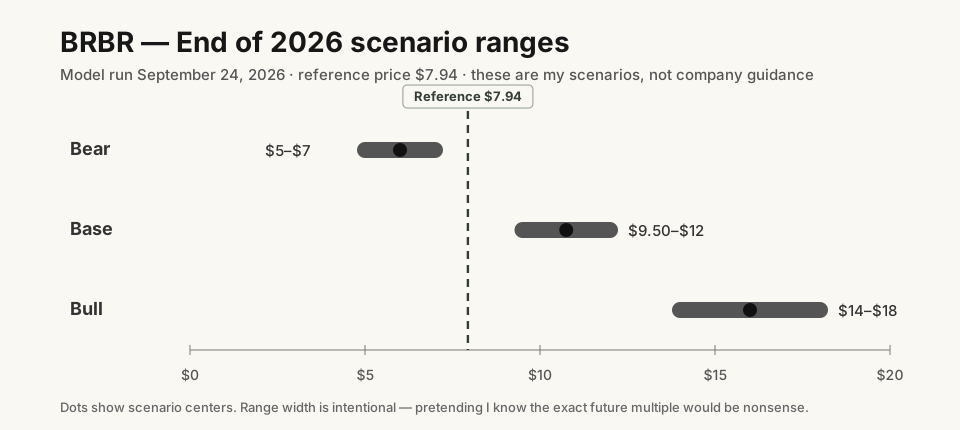
Calling the upside “huge” without numbers would be useless. We already ran the scenarios, so here’s what I’m actually underwriting. These are my ranges, not BellRing guidance, and the reference price when I ran them on September 24 was $7.94. The full model is here if you want to see all the assumptions.
The next few months
For the end of 2026, I had the stock at $5–$7 in a bear case, $9.50–$12 in the base case, and $14–$18 in the bull case. The difference between those outcomes is basically what Q4 and the FY2027 setup tell us about margins, input costs, promotions and whether this whole mess is starting to stabilize.
| EOY 2026 | Price range | Center | Return vs. $7.94 |
|---|---|---|---|
| Bear | $5–$7 | ~$6 | -37% to -12% |
| Base | $9.50–$12 | ~$10.75 | +20% to +51% |
| Bull | $14–$18 | ~$16 | +76% to +127% |
Give it another year
The 2027 model is where it gets more interesting because by then I should have enough evidence to know whether this was actually temporary or I was just making excuses for a broken business. The framework we ran was:
| EOY 2027 | EPS assumption | P/E | Implied price |
|---|---|---|---|
| Bear | $0.80–$1.00 | 7–9x | $6–$9 |
| Base | $1.40–$1.60 | 11–13x | $15–$21 |
| Bull | $1.80–$2.10 | 14–16x | $25–$34 |
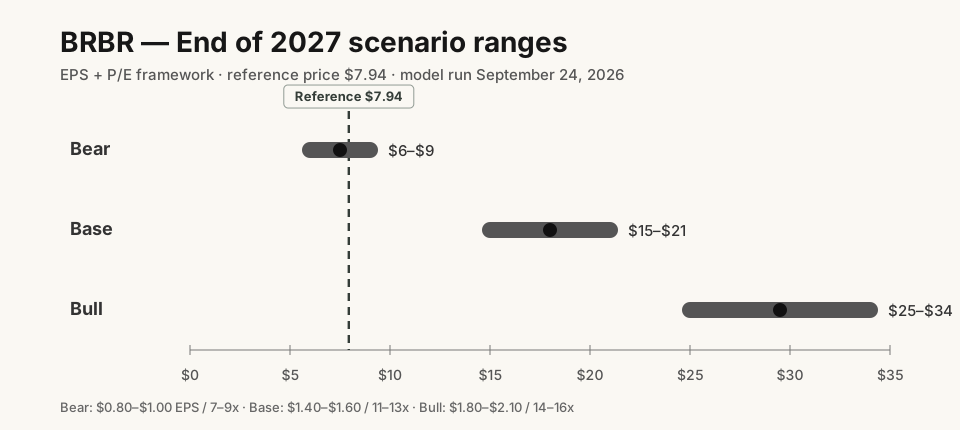
The middle of the 2027 base case is about $18. Nothing magical there: roughly $1.50 of EPS at 12x. From $7.94, the full base range is about +89% to +164%, while the bull range is roughly +215% to +328%. The bear case is also very real at $6–$9, or about -24% to +13% from the reference price.
What $5,000 can actually turn into
That is the math behind why I’m interested, but it’s also the math behind why I don’t need to go insane with the position. The actual purchase was 655.308 shares at about $7.63. If the 2027 base case happens, that position is worth roughly $9.8K–$13.8K. In the bull case it is roughly $16.4K–$22.3K. The position can pay very well without doubling it just to prove I “believe” in the thesis.
And if you want the longer-term sanity check, I ran one of those too. The five-year model came out around $6.30 bear / $28.30 base / $56.80 bull, using explicit revenue, margin, exit-multiple, net-debt and share-count assumptions. There’s also an uglier stress case around $1–$2. I actually like having that in there because otherwise “bear case” has a funny habit of turning into “slightly disappointing outcome.”
Why I still think the brand matters
Premier Protein is still the main reason I’m comfortable taking the swing. It has brand awareness, distribution, repeat purchasing, scale, all the boring stuff that actually matters in a consumer brand. Then there’s the GLP-1 angle, which I do think is real, but I also think it’s incredibly easy to overhype.
More GLP-1 use probably means more people caring about protein intake. Great. Helpful tailwind. If Ozempic needs to rescue the thesis though, I do not want the thesis.
The actual question is much simpler: can Premier Protein stay a category leader while BellRing gets margins back to something resembling normal?
The stuff that still makes me go hmmm
There’s still plenty here that makes me go hmmm. Inventory was $480.6 million at June 30 versus $330.4 million at the end of FY2025, BellRing depends on third-party manufacturing for most of its products, one manufacturer has historically produced nearly half of Premier Protein RTD shakes, there’s real customer concentration, long-term debt was $1.135 billion, and the CEO just changed. None of that means “don’t buy it,” but it definitely means I’m not treating this like some obvious layup. (Q3 earnings release; 2025 Annual Report)
Then there’s the buyback, which is honestly kind of painful to look at. BellRing repurchased $133.1 million of stock at an average price of $27.41 during the first nine months of fiscal 2026. The stock is around $8 now. Oof 😂. (Q3 earnings release)
That does not automatically make management stupid. Where the stock trades later is hindsight, and the fair test is what management knew and what the business was worth at the time. The outcome is not irrelevant either; when judging capital-allocation skill, it absolutely goes in the file.
Why $5,000 is enough
The sizing keeps landing in the same place. The upside case is massive, but too many pieces are unresolved to get cute with the position. More than once I wondered whether $5,000 was too conservative because the upside looked so good. It is not. Putting in $10,000 would mostly confuse a large upside case with a high-confidence outcome, and those are completely different things.
At $5,000, a 3x or 4x outcome still matters. A working thesis leaves me with enough exposure to notice; a total failure is a bad investment, not a portfolio event. That is pretty much exactly what I want from this kind of position.
Why the other $5,000 went boring
The first $5,000 earned its way into BRBR. The next $5,000 did not automatically belong there just because I liked the stock.
This is the part where I can get myself into trouble. Once I like a stock, it is very easy for every new dollar to start feeling like it belongs there too. At some point the position is already large enough to pay me if I am right, and adding more mostly increases how much being wrong hurts.
So the confirmed $10,000 deployment was simple: $5,000 into BRBR and $5,000 into FXAIX. Nothing sexy about the index side, which is exactly fine. BRBR gives me the asymmetric upside. FXAIX gives me broad exposure without requiring me to correctly predict BellRing’s margins, freight costs, promotional spending, inventory cleanup, debt and whether a new CEO nails the turnaround.
What would make me put more money in?
A 20% drop from here changes nothing by itself. More capital needs evidence: margins starting to normalize, inventory coming down without some ugly surprise, pricing holding, Premier Protein defending its position, and the new CEO actually executing. Then maybe I put more money in.
I would much rather average up in evidence than average down because Fidelity decided to make the number redder.
Where I landed
So yeah, that is what actually happened: $5,000 into BRBR at about $7.63 and $5,000 into FXAIX. That was the full $10,000 deployment. Invested assets are now about $320K.
The part I like is that more work produced more upside without producing a bigger position. The answer still was not “cool, throw more money at it.” It was basically: this is good enough to own, uncertain enough to size properly, and attractive enough to deserve exposure.
That feels much more like real investing to me. I did the work, made the call, and stopped at a size where being wrong would hurt without taking over the portfolio.
The trade is done. Now the business gets to do its part.
Sources
Mostly Nothing, when there is actually something to say.
Usually about once a week. Research notes, portfolio decisions, reviews and thesis updates—the useful stuff that comes out of doing the work, whether or not I traded that week.