
AVGO — The stock stopped moving. The earnings did not.
Date: October 2, 2026
Reference price: $355.14 (Oct. 2 close)
My action at publication: No allocation · portfolio overlap
Operating model as of: October 7, 2026
Broadcom looks exactly like the kind of stock where a chart can do too much of the thinking for me.
The shares closed at $355.14, about 28% below the June high of $495. The stock has spent most of the last few weeks bouncing around the mid-$300s while the actual business has been doing something much less boring. (Oct. 2 price)
Q3 revenue grew 86%. AI semiconductor revenue grew 221%. Management is guiding Q4 revenue up 93%. Then it said it has secured enough supply to support roughly $115B of AI semiconductor revenue in FY2027 and sees a path to $230B in FY2028. (Q3 results; Q3 call transcript)
So yeah, the drawdown got my attention.
The awkward part is that the price itself is not actually new. My previous portfolio decision on AVGO used a $352.81 Sep. 25 close. Today’s $355.14 is basically the same number.
That changes the question.
This is not “Broadcom finally got cheap.” It is: does a proper underwriting of the earnings ramp make $355 more attractive than I gave it credit for, and if it does, does the portfolio have room for another AI-infrastructure position?
The first answer is now closer to “maybe, at the right price.”
The second one is still annoying.
Two businesses, one ridiculous cash machine
Broadcom is easier to understand if I stop treating it like one semiconductor company.
There are really two large engines:
- Semiconductor Solutions — custom AI accelerators, Ethernet switching, optical interconnect, wireless, broadband and storage.
- Infrastructure Software — mostly VMware plus the older infrastructure-software assets.
Q3 looked like this:
| Q3 FY2026 | Result |
|---|---|
| Revenue | $29.6B, +86% y/y |
| Semiconductor Solutions | $20.8B, +127% |
| Infrastructure Software | $8.8B, +29% |
| AI semiconductor revenue | $16.7B, +221% |
| Non-GAAP operating income | $20.1B |
| Non-GAAP operating margin | ~68% |
| Free cash flow | $13.7B |
| Q4 revenue guide | ~$34.8B, +93% y/y |
Sources: Broadcom Q3 results and Q3 Form 10-Q.
Those margins are stupid.
Not “nice semiconductor margins.” Stupid.
The software side helps. On the earnings call, management said Q3 infrastructure-software operating margin was roughly 84%, while ARR grew 15%. Semiconductor operating margin was about 61% even with the AI mix pulling consolidated gross margin lower. (Q3 call transcript)
That mix matters because the AI silicon story is becoming enormous, but VMware gives Broadcom a second cash engine that does not need another hyperscaler to order an XPU.
The AI numbers are where the model gets weird
Broadcom expects about $58B of AI semiconductor revenue in FY2026.
Then management gave this:
| AI semiconductor revenue | Management outlook |
|---|---|
| FY2026 | ~$58B |
| FY2027 | ~$115B |
| FY2028 | ~$230B |
That is not an analyst spreadsheet. It is management’s own outlook.
Broadcom says it has secured supply for the FY2027 number, demand is higher than that supply, and it has enough deployment visibility to see the FY2028 trajectory. Hock Tan went as far as saying the company believes with a high degree of confidence it can ship roughly $350B of AI semiconductors across FY2027 and FY2028 combined. (Q3 call transcript)
That needs a giant caveat.
A shipment outlook is not the same thing as guaranteed economic value. Data centers need to be ready. Customers need financing. Supply has to arrive. The products still have to earn their place against Nvidia and other custom-silicon options.
Management itself called out deployment timing as something it worries about.
Still, this changes how I think about the five-year model. A neat “20% EPS growth for five years” shortcut almost hides the more interesting shape of the business: the next two years could be absurd, then growth can slow a lot and the five-year outcome can still work.
VMware is doing more than decorating the story
It would be easy to write the whole thesis around AI chips and treat VMware as the thing Broadcom bought before the fun started.
That misses a pretty important part of the economics.
Q3 infrastructure-software revenue was $8.8B, up 29% year over year. Management said VMware ARR was still growing about 15%, with the segment producing roughly 84% non-GAAP operating margin. Q4 software revenue is expected around $8.7B. (Q3 call transcript)
That gives Broadcom a weirdly attractive combination:
- explosive AI semiconductor growth;
- an extremely profitable infrastructure-software base;
- very little capital expenditure relative to the amount of cash being generated.
Q3 free cash flow was $13.7B on $29.6B of revenue. Capital expenditure was only $532M.
Broadcom is guiding Q4 capex higher to about $1.4B as it invests in semiconductor capacity, but this is still not a foundry business trying to fund a giant fab network itself.
The new risk is that Broadcom is helping finance the demand
This is the part I care about more than I did a month ago.
On the Q3 call, Broadcom described its AI XPV platform with Apollo and Blackstone as a way to use third-party capital to finance large AI infrastructure deployments. Management said it was not directly financing the assets itself, aside from possible modest residual-value guarantees. (Q3 call transcript)
Then Anthropic’s IPO filing added another layer.
Reuters reported on October 1 that Broadcom has agreed to provide Anthropic with up to $42B of financing tied to infrastructure spending and TPU capacity. The instruments may be convertible into Anthropic equity. Anthropic is also expected to become Broadcom’s largest chip-design customer in 2027. (Reuters)
That does not make the AI revenue fake.
It does make the loop more circular.
Broadcom can design the silicon, participate in the infrastructure build, help finance a customer, and then recognize revenue when that customer consumes the hardware. There may be perfectly sensible economics behind all of it. There may also be more counterparty and financing risk hiding inside the growth than a normal “customer ordered chips” model suggests.
This is now the capital-allocation issue I care about most.
Customer concentration is not subtle
Broadcom’s 10-Q says one semiconductor distributor represented 50% of Q3 revenue.
More importantly, the company estimates its top five end customers represented about 55% of Q3 revenue, up from roughly 40% a year earlier. Broadcom explicitly expects significant customer concentration to continue. (Q3 Form 10-Q)
Normally I would hate that.
Here it is partly the business model. There are not fifty companies spending tens of billions on frontier-model infrastructure. The customers Broadcom wants are naturally enormous.
That does not make concentration free. If one hyperscaler changes architecture, delays a campus or brings more design work in-house, the dollars involved are big enough to matter immediately.
The Anthropic financing makes this risk even more worth watching because customer concentration and capital exposure can now overlap.
The balance sheet can handle a lot. That is not permission to do anything.
Broadcom ended Q3 with about $24.0B of cash and $59.4B of debt, or roughly $35.4B of net debt. The debt load is meaningful, but the cash engine makes it look much less scary than the headline number. (Q3 Form 10-Q)
During the first nine months of FY2026, Broadcom:
- generated enormous operating cash flow;
- spent about $8.45B on stock repurchases;
- paid about $9.28B of dividends;
- made roughly $6.05B of net debt payments.
Q3 alone included $5.6B of debt paydown.
The less-clean part is stock compensation. SBC was about $6.3B through the first nine months, and the Q3 GAAP diluted weighted-average share count was slightly higher year over year. The buyback is real; so is the leakage.
The valuation is better than the chart makes it look — and less cheap than the chart makes it feel
At $355.14, Broadcom is roughly 28% off its June high.
That sounds cheap until I remember the equity is still worth around $1.75T using the Q4 diluted-share guide.
External consensus has FY2026 adjusted EPS around $11.66, which puts the stock near 30.5x this year’s adjusted earnings. (Stock Analysis consensus)
Thirty times earnings is not distressed.
The reason the stock can still be interesting is that FY2026 may be a terrible denominator for what the business is becoming.
So I am not using “down 28%” as the valuation model.
My operating model
I start with a FY2026 revenue anchor of roughly $105.9B.
That is simply the reported $71.1B through Q3 plus the $34.8B Q4 guide.
From there I model:
Revenue → operating margin → after-interest/tax income → diluted shares → EPS → terminal P/E
I use an 82% after-interest/tax conversion from operating income as a simplifying assumption. That is my underwriting assumption, not Broadcom guidance.
The starting diluted-share anchor is 4.937B, roughly the Q3/Q4 non-GAAP share-count run rate.
Here is the result:
| Scenario | Revenue CAGR | 2031 revenue | 2031 op. margin | Annual share change | Terminal P/E | 2031 value | 5-year CAGR |
|---|---|---|---|---|---|---|---|
| Bear | 14% | ~$204B | 46% | +1% | 15x | ~$222 | ~-8.9% |
| Base | 24% | ~$310B | 55% | 0% | 22x | ~$624 | ~11.9% |
| Bull | 30% | ~$393B | 59% | -0.5% | 26x | ~$1,027 | ~23.7% |
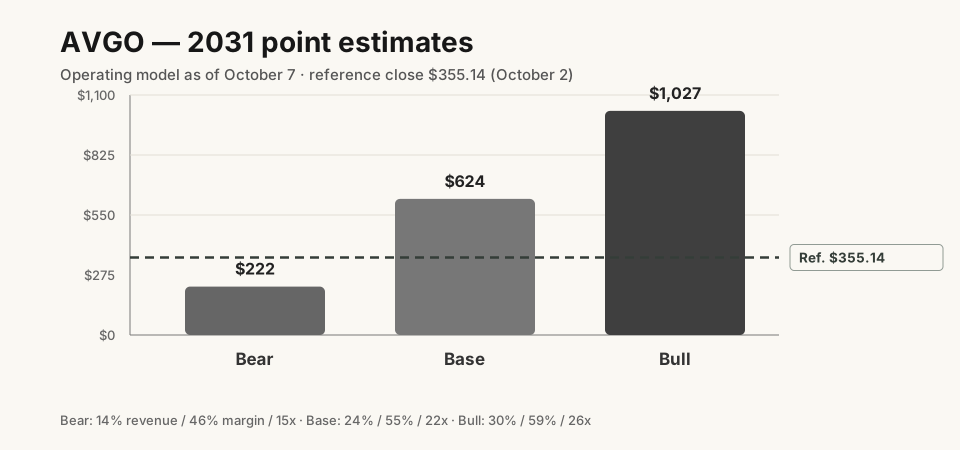
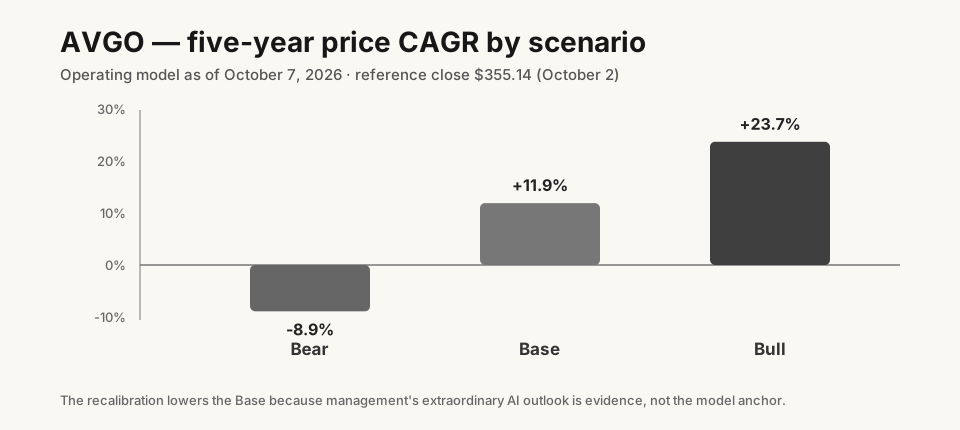
Even the Base asks for a lot: approximately 24% consolidated revenue growth for five years, a 55% operating margin at the endpoint and a flat share count. That puts Broadcom near $310B of revenue and $28.36 of modeled EPS in 2031.
Management’s $230B FY2028 AI outlook is relevant evidence, but it is not guaranteed demand or guaranteed profit. Customer deployment timing, financing and a changing hardware mix all matter to what actually reaches shareholders.
At 22x earnings, the Base endpoint is about $624. Keep those operating assumptions and use 20x instead, and it falls to around $567. There is a credible investment here, but less room for error than the AI revenue headlines imply.
The bear case is basically a vote against management’s AI outlook
The bear still grows revenue 14% annually for five years.
That sounds generous until the endpoint shows up: about $204B of 2031 revenue.
Broadcom is currently saying AI semiconductor revenue alone could reach $230B in FY2028.
So yes, the bear case is implicitly saying management’s FY2027/FY2028 AI path misses materially, the deployment cycle slips, or the business gives back a meaningful amount of the early ramp later.
That is intentional.
A bear case that assumes management’s two-year outlook works and then only trims the terminal multiple is not much of a bear case.
I also ran something uglier
The normal bear still gives Broadcom a large, profitable business.
For permanent-loss thinking I used:
- 12.5% five-year revenue growth;
- 45% operating margin;
- 2% annual share-count growth;
- 14x terminal P/E.
That lands around $181/share, or roughly -12.6% annualized from $355.
No bankruptcy required.
The AI build just needs to produce much less per-share value than today’s expectations imply while the multiple and denominator both move the wrong way.
Reverse the math before getting excited
The Base endpoint is about $624.
Working backward from that:
| Required 5-year return | Approx. entry price |
|---|---|
| 12% | ~$354 |
| 15% | ~$310 |
| 18% | ~$273 |
At $355.14, Broadcom is basically sitting on the starter hurdle, not comfortably inside the normal zone.
That leaves Broadcom looking more fairly priced than outright cheap. The business can be exceptional without the stock clearing the return I want by much.
What the valuation already assumes about the AI ramp
October 8, 2026 perspective; $355.14 October 2 reference price, October 7 operating model. A 22x FY2031 exit at the original price would need only $16.14 EPS to break even. But a 12% annualized return needs $355.14 × 1.12^5 = $625.88 in terminal value, or $28.45 EPS at 22x. At the modeled 4.937B shares, 55% operating margin and 82% net-income conversion, that requires ~$311B FY2031 revenue, roughly 24.1% annual growth from the $105.9B FY2026 anchor. My 24%-growth Base is already close to that hurdle.
| Assumptions for a 12% annualized return | 22x FY2031 P/E | 20x FY2031 P/E |
|---|---|---|
| Required diluted EPS | $28.45 | $31.29 |
| Required revenue, at 55% margin | ~$311B | ~$343B |
| FY2026–2031 revenue growth | 24.1% | 26.5% |
This is a conditional price-implied hurdle, not an analyst-consensus revenue forecast. The dated external ~$11.66 FY2026 adjusted EPS estimate elsewhere in this note is not directly comparable to my FY2031 modeled earnings bridge. Management’s extraordinary FY2028 AI outlook is public information, not automatic proof that the stock is underestimating growth.
The real potential disagreement is whether new custom-accelerator customers produce durable, profitable and cash-collected demand on top of the initial AI ramp while VMware continues supporting consolidated cash generation. Over the next 6–24 months, I would watch customer-specific production deployments, financing and lease exposure, operating margins, cash conversion and the diluted share count. Order announcements without monetization, or customer obligations increasingly carried on Broadcom’s balance sheet, would weaken the case.
The Bull already embeds 30% revenue growth, 59% margin and 26x earnings. A positive surprise has to exceed something substantial: more durable customer breadth or economics than those inputs reasonably capture, supported by contracts turning into revenue and cash. I will not use that hope to increase Base. Early repricing of future EPS is a faster recognition of modeled value, not a separate return added to the $624 endpoint. At this reference price, the standalone 12% hurdle is narrowly missed; the existing AI portfolio overlap remains a separate objection.
Capital allocation: 8.0/10
Using the Capital Allocation Playbook with the Compounder rubric:
| Category | Score | My read |
|---|---|---|
| Reinvestment quality | 2.75 / 3 | Custom AI silicon, networking and VMware are translating spending into extraordinary growth and cash economics |
| Balance sheet / financing | 1.75 / 2 | Net debt is meaningful, but FCF is enormous and debt is coming down quickly |
| Capital deployment | 1.0 / 2 | VMware looks excellent and buybacks/debt paydown are sensible; the Anthropic financing introduces a much larger customer-financing question |
| Strategic focus | 1.75 / 2 | Semiconductors + infrastructure software are unusually coherent for a company built through giant acquisitions |
| Shareholder alignment | 0.75 / 1 | Dividends and repurchases are real, but SBC is large and the diluted share count is not cleanly shrinking |
| Total | 8.0 / 10 | Great capital engine. The new financing loop deserves real scrutiny. |
Broadcom has earned a lot of trust.
VMware is the obvious evidence. The deal was enormous, leverage went up, and the economics since closing have been much better than the lazy “big acquisition = bad” take would suggest.
The reason this does not score higher is that financing customers can muddy the line between productive deployment and supporting demand for your own product.
Maybe the Anthropic facility ends up being a fantastic use of Broadcom’s balance sheet.
It still has to earn that conclusion.
Now the annoying part: I already own a lot of this trade
Using the approximately $320K Oct. 2 invested-assets snapshot and the current company-record position anchors, MU, SK hynix, MRVL and ANET represent roughly 18% of total invested assets combined.
That is before counting the indirect AI-capex exposure sitting inside Microsoft, Amazon, Alphabet and the index.
Broadcom is not identical to those holdings. VMware helps. Custom accelerators are different from memory. Networking is different from memory too.
But the common economic variable is obvious: hyperscalers and frontier labs keep spending absurd amounts on AI infrastructure.
Adding a normal 2%–4% AVGO position on top would push the direct sleeve past 20% pretty quickly.
That matters more to me than whether the ticker itself is different.
AVGO still belongs in the opportunity-cost conversation
MU still has the largest modeled upside, but it is also near its concentration ceiling.
SK hynix still offers a mid-teens Base return on a very different cyclical/security setup.
MRVL has a mid-teens Base return, but it also needs an extraordinary custom-silicon and interconnect ramp to reach that outcome.
ANET offers a lower modeled Base return at its current valuation, despite a very strong AI-networking franchise.
AVGO is closer to the low-double-digits from the current reference price.
Those horizons and risks are different, so this is not a ranking table. That is kind of the point.
Broadcom still belongs in the replacement conversation because the business quality and cash generation are excellent. It just no longer has an obviously superior modeled return that forces me to invent a portfolio excuse for owning zero shares.
Where I land
AVGO is near my standalone hurdle around $355.
The Base is roughly 11.9% annualized from that price. Broadcom is still an excellent business with unusually strong near-term AI visibility and a second cash engine in VMware.
It is just not obviously mispriced anymore.
I am still not allocating net-new capital to AVGO today.
Portfolio overlap is a separate constraint. At around 12% expected annualized return, adding another position exposed to the same AI spending cycle has to beat both the index and the positions I already own.
So the current decision stays Rejected · portfolio overlap.
If I reduce another AI-infrastructure position, AVGO still belongs in the replacement conversation. I would just want either a better price or another round of evidence strong enough to lift the independent Base without borrowing optimism from management’s target.
Zero shares is still the answer.
Broadcom can get back into the conversation if either the price improves or the economics become compelling enough to offset the added concentration.