
ALNT — How much growth is already in the price?
Allient was supposed to be a quick industrial rabbit hole.
Then I found 49% bookings growth, better margins, a bigger backlog and exactly the kind of boring-but-important hardware I naturally like.
Cool.
Then I looked at what the stock was asking me to pay.
That is basically the whole problem. Convincing me Allient is becoming a better business is easy; convincing me it is improving fast enough to justify roughly 42x 2026 consensus earnings is not.
This is the dated work behind why I passed on putting money into it at the reference price.
Reference share price: $116.01 on September 25, 2026.
Everything below is frozen to the evidence and conclusion as of September 26. The current ALNT record can change later.
For valuation I use the simple path from the Bear / Base / Bull Playbook: 2026E EPS → EPS growth → terminal P/E → per-share value → CAGR. Because the starting valuation is the problem, I reverse the math first and ask what Allient has to earn for me to get paid.
I run the Capital Allocation Playbook separately. ALNT fits the compounder rubric: it generates cash, makes acquisitions, pays down debt and has real choices about where the next dollar goes.
Why I kept digging
Allient calls itself a Motion + Controls + Power company, which is accurate and also sounds like something printed on the side of a booth at an industrial trade show.
Fair enough. The business underneath the label is more interesting.
It sells motors, actuators, gearing, encoders, controllers, transformers, harmonic filters and other engineered components that disappear inside much more expensive systems. Automation, aerospace and defense, semiconductor equipment, robotics and data centers all show up in the customer mix.
What I like is that Allient is trying to move further toward integrated engineered solutions instead of staying a collection of component businesses. That does not suddenly give it some magical monopoly, but it can make customer relationships stickier. A generic motor can be swapped. A motion-control-power system that has already been engineered, qualified and integrated into something expensive is a more annoying thing to replace.
Allient also reported no customer above 10% of 2025 sales. 2025 Form 10-K.
The end markets are what make the whole thing tempting. Data centers need a stupid amount of electrical infrastructure that never appears in the sexy AI diagrams, and Allient sells power-quality products that help keep those systems behaving properly. It has also been pushing further into precision motion for robotics and launched the Vyxalon Apex drone drive in August. Vyxalon Apex; ElectroFlux expansion.
The trap here is obvious. Data centers + robots + drones + defense is a very easy way to accidentally build an investment thesis out of exciting nouns.
Cool end markets only matter when they eventually show up in the numbers.
Q2 finally gave me some of that evidence.
Then Q2 made it harder to dismiss
Q2 revenue was $153.8M, up about 10% year over year. That part is solid, not spectacular.
The more interesting numbers were underneath it.
| Reported input | Q2 2026 |
|---|---|
| Revenue | $153.8M, +10% y/y |
| Gross margin | 34.9%, vs. 33.2% |
| Operating income | $15.6M, +34% |
| Operating margin | 10.2% |
| GAAP diluted EPS | $0.61, vs. $0.34 |
| Bookings | $201.3M, +49% |
| Backlog | $298.0M, +26% |
| Cash | $42.1M |
| Long-term debt | $173.3M |
| Approx. net debt | ~$131M |
Primary source: Allient Q2 2026 Form 10-Q.
Bookings of $201.3M against $153.8M of revenue work out to roughly a 1.31x book-to-bill for the quarter.
A 49% bookings jump is not a 49% revenue forecast — that would be dumb. Allient itself warns that backlog is not a perfect predictor of future sales, partly because many products have relatively short lead times.
Still, I would rather spend time figuring out how much strong order growth converts than trying to explain away shrinking demand.
Margins are also moving in the right direction. Gross margin expanded 170 basis points year over year, while operating income grew 34% on 10% revenue growth. That is the kind of operating leverage required before a premium multiple even enters the conversation.
So the business is doing its part.
The stock is where I start arguing with it.
The number that keeps ruining the fun
At $116.01, Allient’s market cap was roughly $1.97B. Using the June balance-sheet debt and cash, enterprise value was around $2.1B.
Consensus estimates were approximately:
| Estimate | EPS |
|---|---|
| 2026E | $2.74 |
| 2027E | $3.33 |
Source: Stock Analysis consensus estimates, last updated September 16, 2026.
At the reference price, the starting point is around 42x 2026 earnings and 35x 2027 earnings.
A higher multiple than the old version of Allient deserved may be justified. Better end markets, expanding margins and more integrated systems should be worth something.
I just still need enough return left after paying for all of that quality. A good story does not help much if most of the upside is already in the starting price.
This is where the reverse math became more useful than trying to decide whether 35x or 42x “feels expensive.”
If I buy at $116.01 and only ask for a 10% annualized return over five years, I need the stock to be worth about $187 in 2031.
What does the business have to earn for that to happen?
| 2031 exit P/E | EPS needed for 10% CAGR |
|---|---|
| 20x | $9.34 |
| 25x | $7.47 |
| 30x | $6.23 |
At a 25x terminal multiple, Allient needs to get from about $2.74 of 2026E EPS to $7.47 in 2031.
That is roughly 22% annual EPS growth for five years.
For a 10% return.
That is the part I cannot get past. Allient could absolutely grow earnings that fast. The problem is underwriting exceptional execution for a merely decent return. If the price or earnings path changes enough, the work can be reopened.
Okay, so what does the full range look like?
Using the same $2.74 consensus EPS starting point, I built three 2031 outcomes.
| Scenario | EPS CAGR | 2031 EPS | Exit P/E | Implied 2031 value | 5-year CAGR |
|---|---|---|---|---|---|
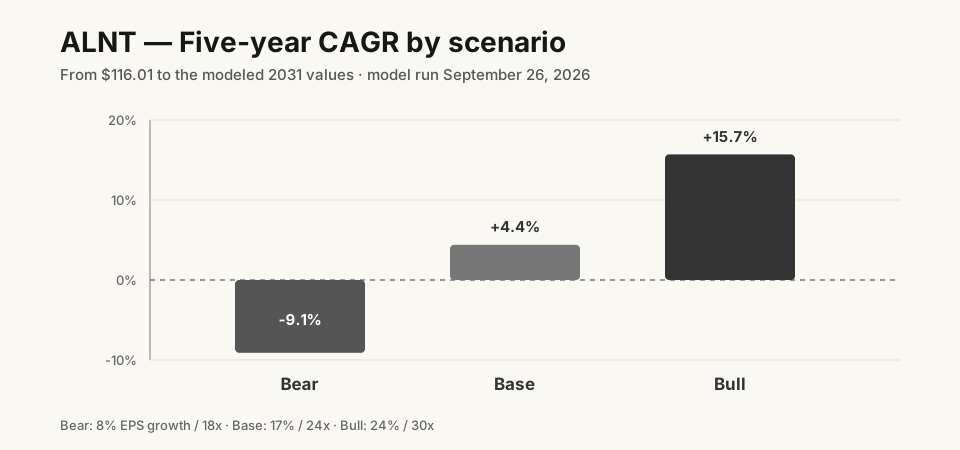
| Bear | 8% | $4.03 | 18x | ~$72 | -9.1% |
| Base | 17% | $6.01 | 24x | ~$144 | +4.4% |
| Bull | 24% | $8.03 | 30x | ~$241 | +15.7% |
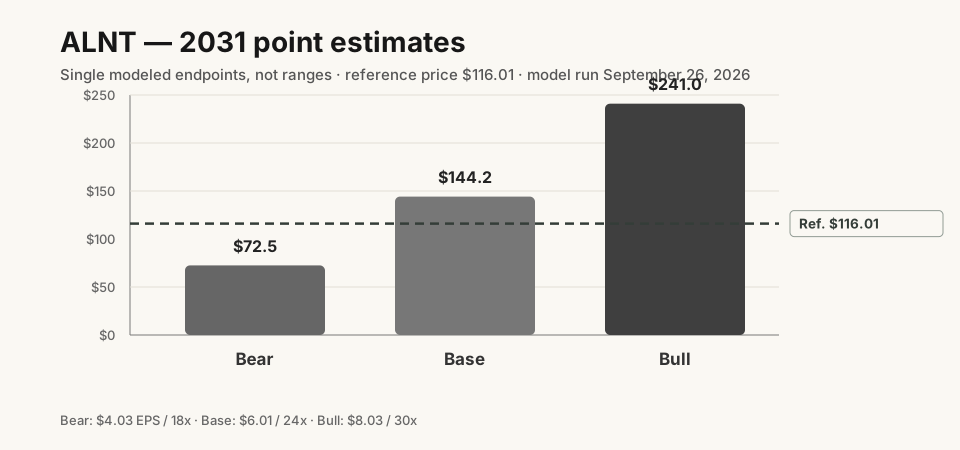
These are single modeled endpoints, not ranges. The stock obviously will not land neatly on $72, $144 or $241. I mostly want the bridge to be obvious enough that I can disagree with myself later.
The bear case is not especially dramatic. EPS still grows to roughly $4.03. The company remains profitable and larger than it is today. Growth just cools, some of the exciting end markets become more normal, margin expansion gets harder, and the market eventually pays 18x earnings instead of 40x+.
That is enough to get me to about $72.
The base case is more uncomfortable because I actually think it is a good operating outcome. Earnings compound at 17% annually for five years and reach about $6.01, then I give the company a still-respectable 24x multiple.
I end up around $144/share.
From $116.01, that is only about 4.4% annualized.
This is why business quality and stock return stay separate. A 17% EPS CAGR for five years would probably mean management did a great job; buying at $116 could still have been a mediocre investment.
The bull case finally gets there. EPS reaches about $8.03, which implies roughly 24% annual growth for five years, and the market still pays 30x at the end.
That produces about $241/share, or 15.7% annualized.
15.7% annualized? Happily.
Needing something close to the bull case to get it is the problem.
The case against my own model
The obvious pushback is that I may still be valuing Allient too much like a normal industrial company while the mix is changing underneath it.
If data-center power quality becomes a much bigger business, integrated Motion + Controls + Power wins show up in margins, and some of the robotics / defense / semiconductor exposure actually scales, the $8 of EPS in my bull case could stop looking heroic pretty quickly.
That argument is not crazy, which is why ALNT stays on my radar instead of going into some permanent “no” pile.
But there are still some very normal industrial-company things attached to this story: cyclical end markets, acquisition and integration risk, debt, goodwill and intangibles, tariff exposure and competitors with substantially more resources. 2025 Form 10-K.
At a lower valuation, those risks are much easier to accept.
At 42x forward earnings, I need the upside assumptions to carry a lot more weight.
What would the market have to be missing?
October 8, 2026 perspective, using the September 26 price and evidence. At $116.01, paying 24x FY2031 earnings would require $4.83 EPS simply to preserve the purchase price ($116.01 / 24). But breaking even is a terrible goal after waiting five years. A 12% annualized return requires a $204.45 endpoint ($116.01 × 1.12^5), or $8.52 EPS at 24x. That’s 25.5% annual EPS growth from the dated $2.74 2026 consensus estimate. My Base calls for 17%.
| FY2031 exit P/E | EPS to break even | EPS for 12% annualized |
|---|---|---|
| 20x | $5.80 | $10.22 |
| 24x | $4.83 | $8.52 |
| 30x | $3.87 | $6.81 |
The multiples are conditional assumptions, not a measured Wall Street consensus. The dated external estimates in this note are $2.74 for 2026 and $3.33 for 2027 (September 16 estimate snapshot). Even at 30x, this is a sizable earnings hurdle; I cannot just call the power-quality opportunity “underappreciated” because it’s interesting.
Over the next 6–24 months, the potential expectations gap gets testable: higher-margin Motion + Controls + Power orders must become recognized revenue, operating leverage should persist, 2027 earnings expectations should rise sustainably above $3.33, and net debt should fall rather than working capital absorbing the growth. Failure to convert backlog or pressure on margins would invalidate the more optimistic interpretation.
A genuine positive surprise would be a sustained mix improvement that drives EPS beyond the existing Bull’s 24%-growth path, without debt-funded acquisitions doing the heavy lifting. That is not in Base. Nor would a faster market rerating be an extra return to add on top of the terminal P/E already in the model. As underwritten, the price still asks for too much before the evidence arrives.
Capital allocation is not why I pass
The slightly annoying part is management is not giving me some obvious capital-allocation disaster I can use as an easy excuse to say no.
There is no obvious balance-sheet stupidity.
Using the Capital Allocation Playbook against the evidence available by September 26, I get:
| Compounder category | Score | My read on Sep. 26 |
|---|---|---|
| Reinvestment quality | 2.0 / 3 | Organic revenue, margins, bookings and backlog are all showing real operating improvement; I still do not have enough repeated evidence to call the incremental-return engine “very good” |
| Balance sheet / financing | 1.5 / 2 | Net debt is meaningful but manageable, debt is moving down, covenants were in compliance and $162.0M of revolver capacity remained |
| Capital deployment | 1.5 / 2 | The acquisitions are strategically coherent and SNC already provides some evidence of sensible economics; I stop short of full credit because the broader acquisition record still has to prove per-share returns |
| Strategic focus | 1.5 / 2 | Motion + Controls + Power is a coherent strategy across internal investment, SNC and Sierramotion rather than random empire building |
| Shareholder alignment | 0.5 / 1 | Acceptable but leaky: diluted weighted-average shares rose about 1% year over year and stock compensation is real, even though dilution is nowhere near large enough to drive the thesis |
| Total | 7.0 / 10 | Pretty coherent. The stock still fails on expected return. |
The balance-sheet direction is worth noting. Allient’s 2025 10-K says net debt fell by about $48.4M during 2025 to roughly $139.7M. In the first six months of 2026, the company generated $20.1M of operating cash flow, spent $7.1M on capex, made $7.2M of net debt payments, remained in compliance with its debt covenants and had $162.0M of unused revolver capacity. 2025 Form 10-K; Q2 2026 Form 10-Q.
The acquisitions also make more than strategic sense on paper. SNC cost about $20M and contributed $3.1M of net income in 2024; Sierramotion cost about $8.4M and added precision-motion / mechatronic capability. The evidence is not broad enough to call the whole acquisition program excellent, but that is better than giving management only middling credit because “M&A is risky.” 2025 Form 10-K.
The shareholder-alignment line goes the other direction. Q2 diluted weighted-average shares increased from 16.713M to 16.875M year over year, and first-half stock-based compensation was $1.845M. That is not a thesis problem. It is enough leakage that the rubric’s 0.5 / 1 anchor fits better than pretending the equity treatment is pristine. Q2 2026 Form 10-Q.
None of that fixes the stock at $116.01.
And that is exactly the point. I can like the business, give management a solid capital-allocation grade, assume a genuinely good operating outcome… and still pass because too much of the future is already in the price.
What would make me care more?
The next update does not need some giant new narrative. I mostly want evidence that the earnings power is catching up with the share price.
The things I would actually watch are:
- whether bookings convert cleanly into revenue
- whether backlog keeps growing without working capital getting ugly
- gross and operating margin progression
- data-center / power-quality demand
- aerospace and defense growth
- whether robotics and drone products become meaningful rather than interesting
- debt reduction
- whether acquisitions create per-share value instead of just adding revenue
- how quickly consensus EPS moves relative to the stock
If those improve faster than the price, the expected return gets better without me needing a selloff.
If the stock falls while the business keeps executing, even easier.
Either way, I do not need to force the issue today.
Where I ended up
At $116.01, I reject allocating capital to ALNT.
The work is worth continuing. The order book is strong, margins are improving, the end markets are attractive and there is a real path to a better business than the historical numbers alone suggest.
The stock is simply asking me to pay for too much of that future today.
The number that sums it up for me is still the base case: 17% EPS growth for five years, 24x at the end, and only about 4.4% annualized from here.
That is a pretty good business outcome and a pretty mediocre investment outcome.
Change that math and ALNT gets interesting very quickly.
For now, somebody else can pay 42x earnings for being early.