
NFLX — Netflix Research Note
Date: September 28, 2026
Reference price: $68.97 (Sep. 28 close)
My action at publication: No allocation · standalone screen passed
I came in wanting a reason to pass
Netflix has never been a company I particularly liked.
That bias is useful context because I went into this expecting: good company, too expensive, move on.
Then the model was annoyingly reasonable.
Netflix is already a scaled global entertainment business with a 30%+ operating margin, double-digit revenue growth, an advertising business that is becoming material, and a share count that is moving in the right direction. At $68.97, the five-year return math is also annoyingly reasonable.
That made this a pretty good test of the whole process. Once the assumptions were on the page, whether I personally liked Netflix stopped being very useful. I had to deal with the return the model was actually giving me.
The remaining question is whether Netflix can keep compounding revenue, expand margins without starving the content engine, and avoid doing something stupid with all the cash.
The business is better than my old mental model
Q2 revenue was $12.56B, up 13% year over year. Operating income was $4.19B and operating margin reached 33.4%. Netflix guided Q3 revenue to $12.86B and a 33.2% operating margin, while full-year 2026 guidance calls for $51.0B–$51.4B of revenue and a 31.5% operating margin. (Q2 shareholder letter)
Those are not turnaround numbers. That is a mature business still growing at a rate I would happily own if the price gives me enough return.
Advertising is becoming harder to dismiss too. Netflix expects roughly $3B of ad revenue in 2026, about double 2025. In Q1, the ad-supported plan represented more than 60% of signups in countries where it was available, and management said the advertiser base had grown to more than 4,000 clients. (Q1 shareholder letter)
Ads do not get some heroic separate valuation here. They only need to become another way to monetize the same audience without making the product worse.
Live programming is similar. Netflix says live is a little over 5% of content spend and roughly 1% of viewing hours, but six of its ten biggest new-member signup days over the prior five years were tied to live events. That is interesting because live can create appointment viewing and advertising inventory without needing to become the majority of what people watch. (Q2 shareholder letter)
The cash flow needs one annoying adjustment
Management currently expects about $12.5B of 2026 free cash flow.
That is not a clean starting point.
Netflix received a $2.8B termination fee after its Warner Bros. transaction ended. In Q1, management explicitly said the 2026 FCF outlook increased from roughly $11B to $12.5B primarily because of the after-tax impact of that fee. So my normalized cash-flow reference is closer to the old ~$11B outlook, not $12.5B. (Q1 shareholder letter)
At roughly a $290B equity value, that is around a 3.8% normalized FCF yield.
Fine. Not obviously cheap on cash flow alone.
The balance sheet is fine. Not pristine. Also not the main thing deciding this. At June 30, Netflix had about $9.1B of cash, restricted cash and short-term investments against $14.3B of short- and long-term debt. (Q2 10-Q)
The Warner Bros. attempt is the part I dislike most
Netflix tried to buy Warner Bros. Discovery.
That matters more to me than the breakup fee.
The deal ultimately died after WBD chose Paramount Skydance, and Netflix collected $2.8B. Financially, that worked out nicely in the short run. The attempt still tells me management is willing to contemplate a very large acquisition when the strategic logic looks attractive.
M&A itself is not an automatic problem. The problem is a business with improving margins, real free cash flow and a shrinking share count deciding it needs to become a media conglomerate.
This is the biggest reason the capital-allocation score looks noticeably worse than the operating business.
I needed a normal starting point before the valuation meant anything
For the valuation model I start with the midpoint of 2026 revenue guidance:
- revenue: $51.2B
- operating margin: 31.5%
- operating income: ~$16.1B
- modeled after-interest/tax conversion: 79%
- normalized net income: ~$12.7B
- diluted-share anchor: ~4.2B
- normalized EPS: ~$3.03
The 79% conversion is my simplifying assumption. Netflix did not guide to it.
At $68.97, that puts the stock at roughly 22.7x normalized 2026 earnings.
That is where my prior started getting pretty uncomfortable, because 22.7x was not the absurd number I expected to find.
Bear / Base / Bull
I ran the Bear / Base / Bull Playbook through the operating drivers rather than starting with an arbitrary EPS growth rate.
| Scenario | Revenue CAGR | 2031 operating margin | Annual share change | Terminal P/E | 2031 value | 5-year CAGR |
|---|---|---|---|---|---|---|
| Bear | 6% | 30% | 0% | 20x | ~$77 | ~2.3% |
| Base | 10% | 36% | -1% | 25x | ~$147 | ~16.3% |
| Bull | 12% | 38% | -2% | 30x | ~$214 | ~25.4% |
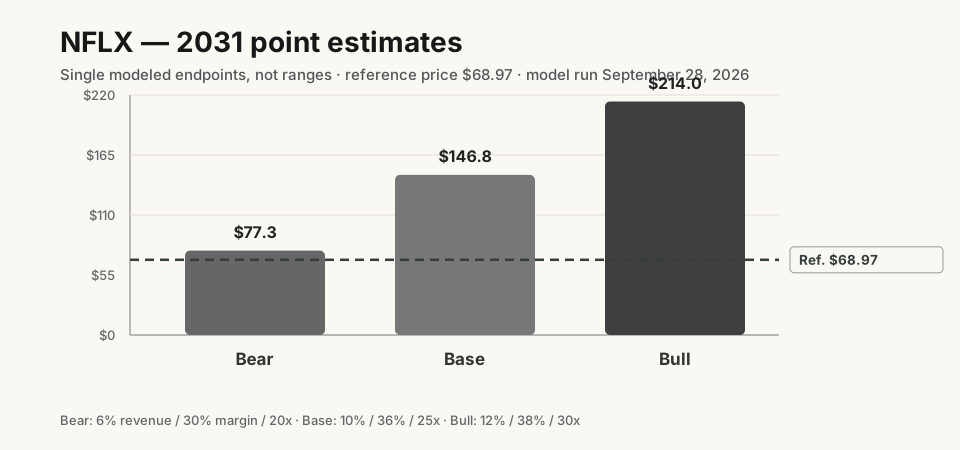
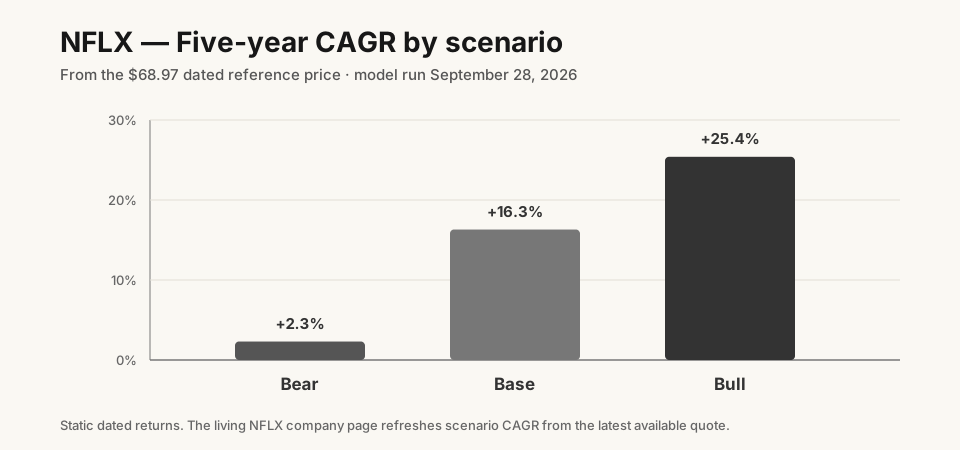
These are point estimates. The spreadsheet does not know the future to the nearest dollar.
The base case is doing real work. Revenue has to compound 10% for five years, operating margin has to reach 36%, and the diluted share count has to shrink about 1% a year. That gets me to roughly $5.87 of 2031 EPS. At 25x, the endpoint is about $147.
None of those assumptions strikes me as heroic. None deserves to be treated as automatic either.
The margin assumption is probably the one I would argue about hardest. Netflix has already shown it can expand margins while still growing, but 36% asks the business to keep getting more efficient even as content, live programming and advertising all compete for investment.
A stress case I actually care about
I also ran a deliberately uglier version:
- 4% revenue CAGR
- 27% 2031 operating margin
- no share shrink
- 17x terminal P/E
That lands around $54, or roughly -4.9% annualized from the reference price.
Netflix does not need to collapse for this investment to disappoint. A slower-growth, lower-margin version of the same business is enough.
What price actually pays me for the base case?
Working backward from the ~$147 base endpoint:
| Required 5-year return | Approx. entry price |
|---|---|
| 12% | ~$83 |
| 15% | ~$73 |
| 18% | ~$64 |
At $68.97, Netflix sits inside my normal zone and fairly close to the aggressive line.
That was the part I genuinely did not expect when I started this.
Disliking the company and the acquisition attempt does not change the math: the current price gives the operating business a pretty reasonable hurdle.
Capital allocation: 7.5/10
I also reran the Capital Allocation Playbook using the Compounder rubric.
| Category | Score |
|---|---|
| Reinvestment quality | 2.5 / 3 |
| Balance sheet / financing | 1.5 / 2 |
| Capital deployment | 1.25 / 2 |
| Strategic focus | 1.25 / 2 |
| Shareholder alignment | 1.0 / 1 |
| Total | 7.5 / 10 |
The positive side is straightforward. Netflix is reinvesting into content, ads, product and live programming while still producing strong margins and cash. The diluted share count is shrinking: Q2 weighted-average diluted shares were about 4.261B versus 4.349B a year earlier. (Q2 shareholder letter)
The deduction is mostly about what management might do with that financial capacity.
The failed Warner Bros. deal is not enough for me to say management is bad at capital allocation. It is enough for me to stop treating a buyback plus a shrinking share count as the whole story.
Where the base case can break
Three things can make the base case too generous.
First, content economics can get worse. Netflix has scale, but there is no law saying the next dollar of content spend has to earn the same return as the last one.
Second, advertising could be strategically useful without being economically transformative. A $3B business is already real. The model does not need it to turn into YouTube.
Third, the margin path may be doing too much of the work. If revenue grows but operating margin stalls around today’s level, the endpoint comes down quickly.
Those are the variables I would rather watch than subscriber headlines.
How much of the ad story is actually needed?
October 8, 2026 perspective, using the September 28 reference price and then-known guidance. Starting at $68.97, a 12% annualized return over five years requires $68.97 × 1.12^5 / 25 = $4.86 FY2031 EPS at a 25x exit P/E. Hold the Base’s 36% operating margin, 79% after-interest/tax conversion and ~3.994B year-five diluted shares, and that’s $68.3B FY2031 revenue, or 5.9% annual growth from the guided $51.2B 2026 anchor.
| Requirements for 12% investor CAGR | At 25x FY2031 P/E | At 20x FY2031 P/E |
|---|---|---|
| Necessary FY2031 EPS | $4.86 | $6.08 |
| Necessary revenue at 36% operating margin | $68.3B | $85.4B |
| FY2026–2031 revenue CAGR | 5.9% | 10.8% |
My existing 10%-revenue-growth Base comfortably exceeds the growth hurdle if Netflix still earns 25x. The same operating case is around the hurdle at 20x. The bigger disagreement is whether a mature streaming/advertising business retains the margin quality and multiple, not whether subscription video is popular. Without a comparable, dated 2031 sell-side model, these are conditional price-implied growth thresholds, not a measured consensus gap.
Management had already forecast roughly $3B of 2026 ad revenue (Q1 shareholder letter). That public guidance is not an unpriced surprise. What would surprise positively is advertising revenue becoming substantially more profitable per viewing hour without raising churn or content costs, or live events producing durable incremental returns after rights spending.
In the next 6–24 months, I’d watch engagement and monetization of the ad-supported tier, advertiser retention, operating margin against the 31.5% 2026 guide, content cash spending relative to reported profit, diluted-share reduction and management’s acquisition discipline. If ad revenue rises while cash margins stall or content spending accelerates, growth deserves a smaller multiple. The existing Bull already gives Netflix 12% top-line growth, 38% operating margin and 2% annual share shrink; that upside can’t be counted twice as an extra “market finally understands ads” premium.
Netflix passes the standalone screen on its own operating assumptions. Whether early earnings revisions drive a faster stock rerating is uncertain—and faster recognition of the same future value isn’t a second return to add to the $147 Base.
The portfolio is where the answer changes
Netflix passes as a Core / Compounder candidate.
It is not an asymmetry position. There is too much existing earnings power and too little binary upside/downside for that framing to make sense.
It also has not earned a portfolio allocation just because the base CAGR is attractive.
This research answers one question: does NFLX deserve to compete for capital?
Yeah, annoyingly, yes.
The next question is harder: is it a better use of the next dollar than adding to something I already own or simply buying the index?
That comparison is still unfinished, so this note does not force a buy inside my portfolio.
The standalone research still passes. A different portfolio with different holdings, concentration and alternatives could rationally act on that conclusion even while mine stays at zero.
What would make me more interested
I get more interested if:
- revenue keeps compounding around double digits without increasingly expensive content growth;
- advertising becomes a meaningful profit contributor rather than just another revenue line;
- margins keep expanding while engagement stays healthy;
- buybacks continue to reduce the share count at sensible prices;
- management stays disciplined after the WBD attempt.
I get less interested if:
- revenue growth settles into the mid-single digits earlier than expected;
- margin expansion stalls or reverses;
- live/content spending grows faster than the economics it creates;
- the ad tier scales users without enough incremental profit;
- management goes back hunting for a giant acquisition.
Q3 results are scheduled for October 20, 2026, which is the next clean checkpoint. (Netflix IR)
Where I ended up
I wanted Netflix to fail the screen.
It refused.
The operating business is stronger than my prior, the valuation is reasonable enough to produce a mid-teens base return without absurd assumptions, and the downside case is more about slow compounding than existential failure.
That does not force NFLX into my portfolio.
It means the standalone investment cleared the screen. The remaining decision is specific to my capital, not a universal verdict on what somebody else should do.